


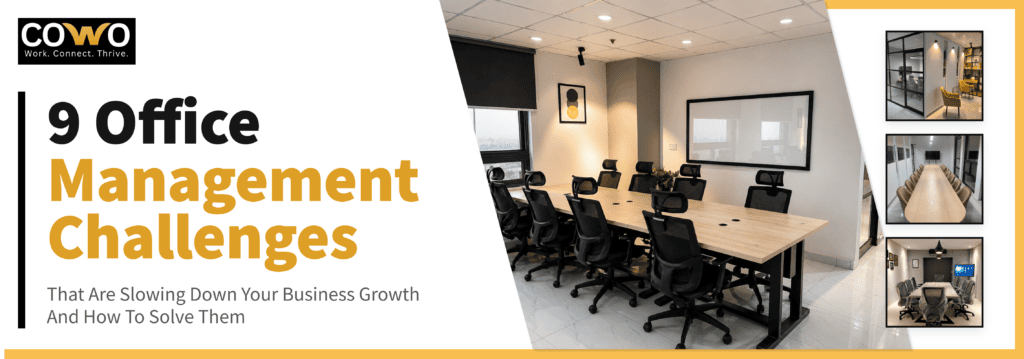
9 Office Management Challenges That Are Slowing Down Your Business Growth (And How to Solve Them)
Every growing business eventually hits the same wall. Sales are up, the team is expanding, and clients are happy, but somehow the office itself becomes the bottleneck. Meeting rooms are always booked, IT tickets pile up, HR is stretched thin, and the lease that once felt spacious now feels cramped. This is not a coincidence. It is a pattern that shows up in almost every company that scales past the startup stage without rethinking how its workspace actually functions.
Office management is not just about desks and chairs. It covers real estate decisions, IT infrastructure, administrative support, security, employee experience, and the flexibility to grow or shrink without financial pain. When any one of these areas breaks down, it quietly drags down productivity, morale, and ultimately, revenue.
The frustrating part is that most of these problems are not caused by bad management. They are caused by outdated office setups that were never designed to flex with a growing business. A lease signed for 15 people does not automatically expand when the team hits 40. A basic router and a shared printer are not real IT infrastructure once client data and remote logins enter the picture. And a single receptionist cannot double as HR, facilities manager, and IT support once the company crosses a certain size.
Below are nine of the most common office management challenges backed by current workplace research, along with practical ways to solve each one.
1. Rising Real Estate and Overhead Costs
Traditional office leases lock businesses into long-term financial commitments regardless of how the company’s needs change. Rent, utilities, maintenance, furniture, and security add up quickly, and most companies end up paying for far more space than they actually use.
Recent workplace benchmarking backs this up. Analysis from workspace research firm Upflex found that most corporate offices run at only 35 to 50 percent utilization on any given day, with 20 to 40 percent of the total real estate budget typically wasted on space that sits unused. That gap between the space companies pay for and the space they actually use is one of the biggest hidden drains on a growing company’s budget.
The fix: Move away from rigid, long-term leases and toward flexible workspace models where you pay for what your team actually needs. Managed office and coworking solutions let businesses scale their footprint up or down without the burden of renegotiating contracts or absorbing unused square footage.
2. Inefficient Space Utilization
Even when a company has enough space, it is rarely used efficiently. Some departments overflow into hallways while entire floors of assigned desks sit untouched because employees are traveling, working hybrid, or simply do not need a fixed seat every day.
According to CBRE’s 2025 Americas Office Occupier Sentiment Survey, roughly 66 percent of organizations report average office utilization below 60 percent, even though 73 percent say their office is effectively at full capacity on peak days. Separate research from JLL’s 2025 Occupancy Planning Benchmark Report puts global office utilization at just 54 percent on average. This mismatch between quiet weekdays and overcrowded peak days makes it nearly impossible to plan layouts, budgets, or headcount growth accurately using assigned seating alone.
The fix: Shift toward flexible seating and shared workspace layouts that adjust to real attendance patterns instead of theoretical headcount. Facilities that offer scalable floors and shared amenities let businesses expand into more rooms only when they genuinely need it, rather than guessing months in advance.
3. Lack of Scalable Infrastructure
A workspace designed for 20 people rarely works well for 60, and rebuilding an office every time the team doubles is expensive and disruptive. Businesses that grow quickly often find themselves stuck between an office that is too small and a renovation that takes months to complete.
This is exactly the gap that enterprise-focused workspace providers are built to close. There are now dedicated enterprise coworking and office solutions in Lahore designed for teams ranging from 20 to more than 200 employees, with private floors and infrastructure that can expand or contract as the business evolves, without the delays and costs of a traditional office build-out.
The fix: Choose a workspace partner that offers scalable infrastructure from day one. This means private floors that can be reconfigured, additional capacity available on short notice, and a setup that grows alongside the company instead of holding it back.
4. Fragmented IT and Tech Support
As teams grow, so does the complexity of managing internet reliability, network security, hardware, and day-to-day tech troubleshooting. Many businesses, especially small and mid-sized ones, do not have a dedicated in-house IT team, which means a single connectivity issue can bring an entire department to a standstill.
The financial impact is measurable. Research compiled by Standley Systems shows small business downtime typically costs between $137 and $427 per minute, meaning a single three-hour outage can cost a company anywhere from roughly $24,600 to $76,800 once lost productivity and recovery work are factored in. Fragmented IT also creates security exposure: the Verizon 2025 Data Breach Investigations Report found that small and mid-sized businesses experience ransomware breaches at more than double the rate of large enterprises, at 88 percent versus 39 percent of total breaches.
The fix: Work with a managed office provider that bundles enterprise-grade IT support, secure networks, and access control into the workspace itself. This removes the burden of building an internal IT department from scratch and ensures technical issues are resolved quickly by people who manage the infrastructure daily.
5. Weak Administrative and HR Support
Founders and managers often end up doing far more administrative work than they should, from managing vendors and supplies to handling front-desk operations and basic HR tasks. This pulls leadership attention away from strategy and slows decision-making across the business.
As headcount grows, the administrative burden grows with it. Without dedicated support, tasks like onboarding new employees, managing facilities requests, and coordinating day-to-day operations start eating into hours that should be spent on actual business growth. Industry data on flexible workspace adoption shows that outsourcing routine administrative functions to a managed workspace provider can cut operational overhead by close to 18 percent, simply because the tasks are handled by specialists instead of stretched internal staff.
The fix: Outsource routine administrative and operational tasks to an on-site team that specializes in workplace management. Dedicated support staff for daily operations, maintenance, and general administration free up leadership to focus on the business instead of the building.
6. Poor Employee Experience and Low Engagement
The office environment has a direct impact on how engaged and productive employees feel. Poor lighting, uncomfortable seating, noisy open floors, and a lack of quiet spaces for focused work all contribute to burnout and disengagement over time.
This is not a minor detail. Gallup’s State of the Global Workplace 2025 report found that only 21 percent of employees worldwide are classified as engaged, a gap that costs the global economy an estimated $438 billion in lost productivity every year. Gallup’s research also puts the cost of replacing a single employee at 50 to 200 percent of their annual salary depending on the role, which makes retention a direct line item, not just a soft metric.
The fix: Invest in a workspace that balances collaboration areas with quiet zones, wellness spaces, and comfortable common areas. A well-designed office is not a perk. It is a retention tool that reduces turnover and keeps teams performing at their best.
7. Inflexible Lease Terms
Traditional commercial leases typically run three to five years, which can be a serious liability for businesses that are still figuring out their growth trajectory. A company that signs a long lease based on today’s headcount often finds itself either paying for unused space or scrambling to find room for new hires within the same walls.
This is one of the biggest reasons flexible workspace has grown so fast. Fortune Business Insights valued the global flexible office market at $45.24 billion in 2025, projecting growth to $51.99 billion in 2026 and roughly $194.75 billion by 2034. CBRE’s European Office Occupier Sentiment Survey 2025 found that occupiers now aim to hold 29 percent of their total real estate portfolios in flexible space by 2027, specifically to reduce long-term capital commitments. Separately, workspace provider IWG reports that 79 percent of hybrid companies using flexible space saw measurable cost savings.
The fix: Choose flexible membership or lease structures that allow month-to-month or short-term commitments. This gives businesses room to adjust their workspace footprint in step with actual demand, rather than being locked into a decision made years earlier.
8. Security and Access Control Gaps
As teams grow and more people move in and out of the office daily, controlling who has access to what becomes increasingly difficult. Many small and mid-sized businesses still rely on basic locks and shared keys, which leaves sensitive areas and equipment vulnerable.
For enterprises handling confidential client data or proprietary information, weak physical security is not just an inconvenience. As noted above, the Verizon 2025 DBIR found smaller businesses are breached at more than double the rate of large enterprises, which is one reason modern flexible workspaces have moved quickly toward better controls. Industry tracking shows roughly 75 percent of flexible workspaces have now implemented contactless entry systems as a baseline security standard rather than a premium feature.
The fix: Look for workspaces with enterprise-grade access control, including keycard or biometric entry, monitored common areas, and clearly defined private zones for sensitive teams. Security should scale automatically as headcount grows, not require a separate overhaul every time the team expands.
9. Difficulty Managing Remote and Hybrid Teams
Hybrid and remote work have become the norm for many businesses, but managing a distributed workforce brings its own set of office management headaches. Coordinating who is in the office on which day, ensuring remote employees have equal access to resources, and maintaining a consistent company culture across locations are all ongoing challenges.
Data from Cushman & Wakefield shows that 55 percent of global occupiers now use flexible office solutions as part of their hybrid strategy, with another 17 percent planning to increase usage. Meanwhile, CBRE’s 2026 Global Workplace and Occupancy Insights found office utilization climbing to 53 percent, up from 38 percent in 2024, showing that companies are bringing people back in, but on more flexible, intentional terms rather than rigid five-day schedules.
The fix: Build a workspace strategy around flexibility rather than fixed schedules. On-ground operational support that manages day-to-day logistics, combined with scalable private floors, allows businesses to accommodate hybrid attendance patterns without wasting space or budget.
Turning Office Management from a Burden into an Advantage
Office management challenges rarely announce themselves loudly. They show up as small frustrations, a delayed onboarding, a meeting room that is never free, an IT ticket that takes two days to resolve, and over time these small frictions compound into real barriers to growth.
The good news is that none of these challenges are unsolvable. Businesses that recognize the pattern early and shift toward flexible, professionally managed workspaces consistently free up time, budget, and mental bandwidth that would otherwise go toward running the office instead of running the business.
The most effective long-term fix is rarely a single tool or a one-time policy change. It is a shift in how a company thinks about its workspace altogether, treating it as a flexible, managed service rather than a fixed asset that has to be planned years in advance. Companies that make this shift early tend to spend less time firefighting operational issues and more time actually executing on growth plans, hiring faster, launching new initiatives sooner, and keeping employees focused on their actual work instead of office logistics.
If your team is feeling the strain of any of the challenges above, it may be time to rethink your workspace strategy altogether. Cowo provides fully managed coworking spaces and enterprise office solutions in Lahore, built to remove exactly these kinds of operational bottlenecks so your team can focus on what actually drives growth.