


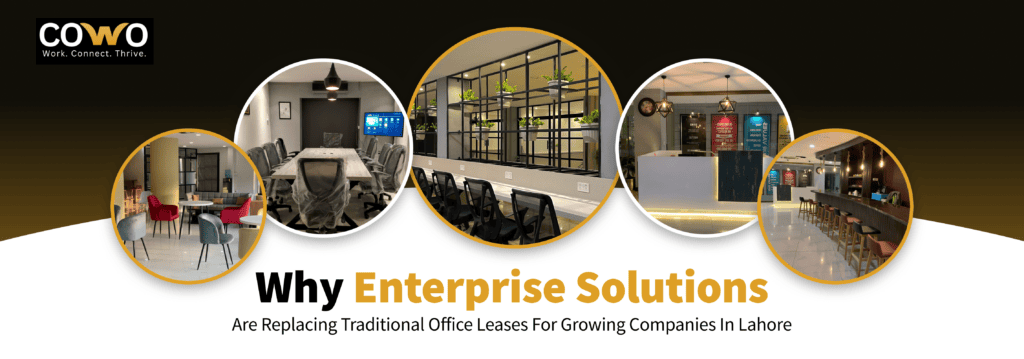
Why Enterprise Solutions Are Replacing Traditional Office Leases for Growing Companies in Lahore
Lahore’s office market is changing faster than most lease contracts can keep up with. Between July and October 2025, Pakistan’s Securities and Exchange Commission (SECP) registered 14,802 new companies across the country, and Punjab alone accounted for 7,476 of them, more than half the total. A large share of this growth comes from IT, e-commerce, and services companies in Lahore, the same companies that hire fast, change team size often, and need office space that can keep up with them. A three-year lease signed today may not match the team size a company has by next quarter.
This is why enterprise solutions are becoming the first choice for growing companies in Lahore, instead of the traditional office lease. The shift isn’t only about saving money, although the savings are real. It’s about choosing a workspace that can grow and shrink with the business, instead of locking a company into one fixed plan for years.
The Traditional Lease Model Wasn’t Built for This Pace
Office rent in Lahore changes a lot depending on the area and size of the space. Rents start as low as PKR 10,000 a month for small offices and go up to PKR 3 million a month for large corporate floors in prime areas, according to listing data from Zameen.com. In Gulberg, a small or mid-sized office can cost between PKR 200,000 and PKR 500,000 a month, while in Johar Town, prices range from around PKR 50,000 to PKR 1.5 million a month for premium space. These rent figures are only the starting point. Before a single desk is even set up, a growing company usually has to plan for several costs that sit outside the monthly rent:
- A security deposit, often two to six months of rent paid upfront
- Advance rent, usually required on top of the deposit
- Fit-out work, including flooring, electrical wiring, and partitions
- Furniture and fixtures bought from scratch
- Backup generators and fuel to handle load-shedding
- IT cabling, networking, and basic server setup
Add all of this together, and moving into a traditional office in Lahore often costs close to a full year’s rent before a single employee has actually started working.
If a company outgrows its office in eighteen months, or has to downsize after a slow year, that upfront money is gone. Most landlords also prefer long contracts and large deposits, since that protects their own income, not the tenant’s flexibility. Renewals happen on the landlord’s schedule, and breaking a lease early almost always costs money. In short, a traditional lease asks a growing company to guess its own future headcount years in advance, something very few founders or office managers in Lahore can do with much confidence.
Lahore’s Business Boom Is Outpacing Lease Cycles
The scale of new business activity makes the problem easier to see. Pakistan’s total number of registered companies reached 272,918 by the end of October 2025, and IT and e-commerce led new company registrations almost every month that year. Punjab, where Lahore is the main business hub, regularly contributes the largest share of these new companies. Much of this growth is happening because SECP has made registration almost entirely digital, with about 99.9% of new companies now incorporated online. That has made it easier for small teams to formalize into proper companies earlier than before, which means more of them are renting office space earlier in their growth too.
A startup that begins with eight people in a small rented room can be hiring its thirtieth employee within a year, and its fiftieth the year after. Most commercial leases in Lahore run for two to three years with very little flexibility built in. That means a fast-growing company either pays for space it doesn’t need yet, or runs out of room and has to move in the middle of its growth, losing time at the worst possible moment.
What an Enterprise Solution Actually Replaces
An enterprise solution replaces that fixed, multi-year contract with a private, fully managed floor that grows with the team instead of holding it back. At COWO, an enterprise solution gives companies a private floor or suite built for 20 to 200+ employees, with most of the groundwork already in place before the team moves in. That usually includes:
- IT infrastructure and internet already installed and tested
- HR support for day-to-day staffing and admin questions
- On-site help with daily operations, maintenance, and upkeep
- Access control and security for the whole floor
- Meeting rooms, lounges, and other shared amenities included in the agreement
A company simply adds desks as it hires, or releases them after downsizing, instead of breaking a lease or paying to rebuild a new office. None of these pieces need to be arranged separately, which is usually where the real delay happens with a traditional setup. The office becomes a cost that moves with the business plan, not a fixed expense sitting on the books no matter what the year actually looks like.
Enterprise Solutions Fit How Lahore Companies Actually Hire
Growth in Lahore rarely moves in a straight line. An IT services company might win one big contract and need fifteen new developers within two months, then stop hiring while that project runs. A company handling remote teams or back-office work for clients abroad might need to staff up a night shift fast, then shrink it once a contract ends. Export-focused businesses see a similar pattern, adding a full sales and logistics team for a few months around a seasonal order, then scaling back once it ships. Locking that kind of short-term growth into a three-year lease rarely makes financial sense.
None of this fits well inside a contract signed years ago for one fixed floor plan. An enterprise solution is built for exactly this kind of change, letting a company use 25 seats this quarter and 70 the next without renegotiating anything, because the space itself is designed to expand and shrink with demand.
The Real Cost Comparison Behind the Shift
The numbers support this shift well beyond Lahore too. Companies that move from a long-term traditional lease to flexible workspace terms report saving close to 25% on real estate costs over time, and the global flexible office market is expected to grow from about USD 45.24 billion in 2025 to USD 51.99 billion in 2026, according to Fortune Business Insights. Research from Cushman & Wakefield found that 55% of companies worldwide already use flexible office space, and another 17% plan to use more of it soon. Locally, an enterprise solution starting around PKR 35,000 per seat per month removes most of the upfront cost completely, compared with a traditional Lahore lease where the deposit, advance rent, and fit-out can add up to a full year’s rent before a single employee even shows up.
There’s also a simpler accounting angle worth noting. A traditional lease usually sits on the books as a long-term commitment, tied to furniture and fit-out that depreciate slowly over years. An enterprise solution behaves more like a regular monthly cost, easier to plan around and easier to explain to an investor or a board that prefers lean, flexible spending over a fixed long-term liability.
Scaling Without Carrying the Operational Weight
A traditional office lease in Lahore also brings a second, quieter cost: running everything yourself. Once the lease is signed, the tenant becomes responsible for a long list of day-to-day tasks that have nothing to do with the actual business, including:
- Generator fuel and maintenance during load-shedding
- Backup internet in case the main connection drops
- Building security and visitor management
- Cleaning staff and general upkeep
- Biometric access systems and ID management
- The HR time needed to coordinate all of the above
An enterprise solution wraps all of this into one managed agreement, so a team growing from 60 to 90 people doesn’t need to hire a facilities manager or set up a new internet connection. It just adds desks on a floor that’s already running. CBRE’s 2026 Global Workplace & Occupancy Insights report found that office space use climbed to 53% this year, up from 38% in 2024, showing that companies everywhere are using their space more carefully instead of holding onto room they don’t actually need.
Where This Leaves Lahore’s Office Market
Traditional leases aren’t going away from Lahore overnight, but they’re losing ground with growing companies. A CBRE survey of businesses across Europe found that companies now plan to keep close to 29% of their total office space in flexible arrangements by 2027, driven by the same pressures Lahore’s IT and services companies deal with daily: unpredictable hiring, shorter project cycles, and less appetite for locking up cash in a 36-month commitment. Hybrid work plays a role too. As more Lahore teams split time between home and office, companies need less full-time floor space but still want a proper business address and meeting rooms ready when staff do come in, something a traditional lease struggles to support.
As more local and international teams set up across Lahore, the city’s flexible workspace sector is following a pattern already seen across Asia, where this kind of office space is growing faster than almost any other part of commercial real estate.
For a Growing Lahore Company, the Decision Is Becoming Simple
A company hiring ten people this quarter, and maybe thirty by next year, isn’t well served by a model built on the idea that its size won’t change for three years. Enterprise solutions exist for exactly this kind of uncertainty, giving growing teams private, secure, fully staffed space without forcing them to guess a headcount they can’t really predict yet. The real question for a growing company isn’t about location or amenities anymore. It’s whether the office itself can keep up with how fast the business actually plans to move. As COWO keeps expanding its presence across Lahore, the companies moving fastest are the ones that have stopped treating office space as a long bet and started treating it as something that simply grows with them.