

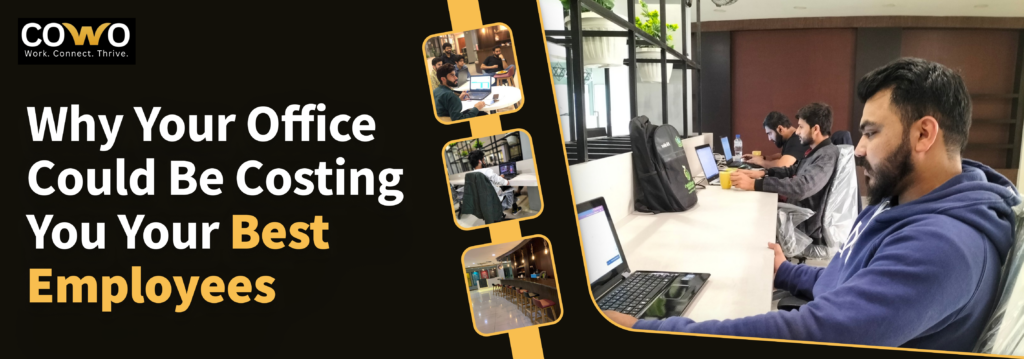
Why Your Office Could Be Costing You Your Best Employees
When a strong employee resigns, the office is rarely the first thing a company blames.
The conversation usually starts with compensation, management, workload, career progression, or a better offer elsewhere. Those are important factors, and in many cases they are the main reason someone leaves. But focusing only on the obvious reasons can hide another part of the employee experience that people deal with every working day: the environment in which they are expected to perform.
A frustrating office does not usually create a resignation overnight. It works much more slowly.
It is the developer who struggles to focus because calls are happening around them all afternoon. The manager who cannot find a private room for a sensitive conversation. The employee who spends time commuting to work only to discover that the meeting rooms are full and the internet is unreliable again. It is the growing team that still technically fits into the office, but no longer has enough functional space to work comfortably.
None of these problems sounds dramatic on its own. When they become part of a normal working week, however, they begin to shape how employees feel about the company itself.
There is research behind that connection. Gensler’s 2025 Global Workplace Survey, based on more than 16,000 office workers across 15 countries and 10 industries, found that employees in great workplaces were nearly three times more likely to stay with their company. The same research found that only 26% of employees strongly agreed that their current workplace helped them do their best work.
That does not mean office design matters more than leadership or salary. It means businesses should stop treating the workplace as a neutral background. A good office can remove friction from an employee’s day. A poor one can quietly add to it.
The Cost Usually Starts With Friction, Not Resignations
Before an office becomes a retention issue, it normally becomes a productivity issue.
Employees begin adapting to things that should simply work. They move around the office looking for somewhere quiet. They schedule important calls around room availability. They bring their own equipment because the existing setup is uncomfortable. They leave the building for conversations that require privacy.
These behaviours are easy to miss because employees are often good at finding temporary solutions.
Recent workplace research suggests this is happening at considerable scale. Gensler’s 2026 Global Workplace Survey found that two-thirds of employees were “hacking” their workspace to compensate for performance gaps. Around one in four had created their own fixes for problems related to ergonomics, temperature, or visual privacy. Meeting-space availability and noise also remained persistent challenges.
That is an important signal for employers.
When employees constantly have to fix the environment around them before they can work effectively, the office is transferring its problems to the people using it.
A small inconvenience once a month may not matter. Repeated friction does. It consumes attention, breaks concentration, and gradually creates the feeling that getting work done is harder than it needs to be.
Gallup’s retention research adds another useful perspective. 42% of employees who voluntarily left an organisation said their manager or employer could have done something to prevent their departure. Among preventable leavers, organisational frustrations, workload, staffing, management, compensation, and career development all appeared as areas where employees believed intervention could have helped.
The workplace is not responsible for all of those problems. But an office that repeatedly creates avoidable friction can easily become part of the wider experience that makes someone receptive to another opportunity.
Enough Desks Does Not Mean the Office Still Works
Office capacity is often measured too simply.
A business has 40 employees and enough desks for 40 people, so on paper the space still works. In reality, those employees may need completely different environments throughout the day.
A developer may need several hours of uninterrupted concentration. Salespeople may spend much of their day speaking to prospects. Managers need spaces for private discussions. Finance and HR teams may handle sensitive information. Project teams regularly need to sit together and work through problems.
When all of those activities compete for the same type of space, employees start compromising.
The problem is not necessarily that the office is too small. It may simply be too limited in the types of work it can support.
Gensler’s 2025 research found that employees with greater choice over where and how they work were 2.5 times more likely to say their workplace supported both individual and team productivity. Access to private spaces, flexible environments, and control over factors such as noise were associated with stronger workplace experiences.
For employers, this changes the question from “How many people can we fit here?” to “How many different kinds of work can happen here without people getting in each other’s way?”
That is a much better measure of whether an office is actually working.
Noise Is Not the Problem. Lack of Control Is.
A completely silent office is neither realistic nor desirable for most teams.
Healthy workplaces contain conversation, collaboration, client calls, meetings, and spontaneous discussions. Those interactions are part of why many people still value working together in person.
Problems appear when every activity has to happen in the same environment.
A salesperson should be able to speak confidently with a customer without worrying that five colleagues are trying to concentrate a few feet away. Someone preparing a complex report should not need headphones all day just to create enough separation to think.
This is why workplace choice matters more than simply choosing between an open office and a closed one.
Employees need somewhere suitable for the work in front of them.
For many businesses, that means providing a reasonable mix of focused areas, meeting rooms, private spaces, and more informal areas for collaboration. The exact combination will depend on the team, but the principle is simple: employees should not have to fight the office every time their task changes.
Gensler’s 2026 research reinforces this point. Manageable noise levels, easy access to spaces for focused concentration, flexible furniture, current technology, and areas for rest or recharge were among the workplace factors associated with effectiveness.
Privacy Is Part of Doing the Job Properly
Privacy is sometimes treated as a preference. In many roles, it is a practical requirement.
Managers need private conversations with employees. HR teams deal with sensitive information. Salespeople discuss confidential client matters. Recruiters interview candidates. Finance teams work with information that should not be visible or audible to everyone nearby.
When privacy is difficult to find, people improvise.
An employee takes a call from a corridor. A manager postpones a conversation until a room becomes available. Someone leaves the office entirely because discussing the issue at their desk would be inappropriate.
This may look like a minor inconvenience from a facilities perspective, but it affects how professionally and comfortably employees can do their work.
An office does not need to give everyone a private room. It does need to provide enough variety that privacy is available when it genuinely matters.
The distinction is important because collaboration and privacy are not competing ideas. Good workplaces support both.
The Office Has to Earn the Commute
The rise of hybrid work changed the value equation around offices.
Employees who know they can complete certain tasks elsewhere naturally compare the office with their alternatives. When they commute into work, they expect the workplace to offer something useful in return.
That could be easier collaboration, access to colleagues, professional meeting spaces, better equipment, stronger infrastructure, fewer home distractions, or simply a setting where they can focus more effectively.
There is evidence that employees still value the physical workplace. Gensler’s 2025 research found that employees spent around 55% of their working week in the office, yet believed they needed the office for closer to 65% of their week to perform at their best.
So the issue is not simply that employees no longer want offices.
The bigger question is whether the office gives them a worthwhile reason to be there.
A long commute becomes much harder to justify when the employee arrives and cannot find a meeting room, struggles with the internet, or spends the entire day on video calls from a noisy desk.
Businesses that want employees to value office time should therefore focus less on attendance itself and more on what the employee can actually accomplish once they arrive.
Growing Companies Often Outgrow Their Office Before They Realise It
Workplace problems tend to appear gradually as a business expands.
A space that works comfortably for 15 employees may still seem fine at 25. When the team reaches 30, another row of desks is added. At 40, meeting rooms become harder to book. By 50, different teams are constantly competing for quiet areas, private conversations, and shared facilities.
Everyone may still have a seat, which makes the problem easy to underestimate.
But floor capacity and functional capacity are not the same thing.
Every new employee adds more than one desk. They add calls, meetings, visitors, internet usage, shared-facility demand, and interactions with other teams. As the company grows, the pressure on the environment grows with it.
Businesses should therefore evaluate office growth based on experience, not simply occupancy.
Useful questions include:
- Can employees still find meeting space without planning days ahead?
- Do people have somewhere suitable for confidential conversations?
- Can focus-heavy teams work without constant interruption?
- Is infrastructure keeping up with headcount?
- Does adding new employees noticeably reduce comfort for everyone else?
When the answer to several of these questions is no, the company may have outgrown the workplace even if there are still empty corners where another desk could fit.
Basic Comfort Has a Bigger Impact Than Fancy Perks
It is easy to focus on visible office perks because they photograph well.
Employees may appreciate a stylish lounge, free coffee, or an impressive reception area, but these extras do not compensate for uncomfortable chairs, poor ventilation, unreliable internet, inadequate lighting, or a temperature that becomes a daily distraction.
The basics matter because employees interact with them for hours.
OSHA notes that good ergonomics, which means fitting work to the person, can reduce muscle fatigue, increase productivity, and reduce the number and severity of work-related musculoskeletal disorders.
Indoor conditions can also affect how people perform. Research from Harvard’s Healthy Buildings program involving office workers across six countries found associations between indoor air quality and cognitive performance. For every 500 ppm increase in CO2, used as a proxy for ventilation, response times were approximately 1.4% to 1.8% slower, while correct responses per minute also declined.
Employees do not need to understand the research to experience the effects of a poor environment.
They simply know that the chair hurts by late afternoon, the room feels uncomfortable, the internet interrupts meetings, or they feel noticeably more productive somewhere else.
The best workplace infrastructure often goes unnoticed precisely because it works.
Your Office Becomes Part of How Employees Judge the Company
Companies spend considerable time defining their culture.
They talk about collaboration, trust, employee wellbeing, flexibility, and high performance. The workplace is one of the places where employees test whether those ideas feel real.
If a company says it values people’s time but repeatedly allows preventable workplace problems to waste it, employees notice the contradiction.
If collaboration is supposedly important but suitable meeting space is almost impossible to find, employees notice that too.
This does not mean workplace quality should be confused with culture. A modern office cannot repair a poor manager, unfair compensation, excessive workload, or a lack of career progression.
Those problems need to be solved directly.
The point is that once an organisation gets the fundamentals right, the physical workplace should reinforce the employee experience rather than undermine it.
That matters even more for high performers because talented employees usually have more options. They are more likely to hear from recruiters, receive referrals through their professional network, or know what working conditions other employers provide.
A frustrating office may never be the only reason they leave. It can still become one more reason that makes another opportunity feel attractive.
The Warning Signs Usually Appear Before the Resignation
Companies do not need to wait for exit interviews to discover that their office is creating problems.
The clues are often already visible.
Employees may regularly leave the office to find somewhere quiet. Meeting rooms may be booked from morning to evening. Managers might struggle to find privacy for one-on-ones. Teams may repeatedly raise the same complaints about noise, temperature, internet reliability, seating, or maintenance.
Another useful signal is voluntary office attendance. When employees consistently avoid the workplace unless an important meeting requires them to be there, employers should resist the temptation to assume they simply prefer working from home.
Ask why.
Broad questions such as “Do you like the office?” rarely uncover much. More specific questions produce better information:
- What regularly makes it harder to work here?
- Where do you go when you need to concentrate?
- Which spaces are hardest to access when you need them?
- What workplace problem wastes the most time?
- What would make a day in the office more productive?
A single complaint may reflect personal preference. When the same issue appears across multiple employees or teams, it becomes a pattern worth investigating.
Gallup’s turnover research offers a useful warning here as well. 45% of voluntary leavers said that neither a manager nor another leader had proactively discussed their job satisfaction, performance, or future with the organisation in the three months before they left.
Sometimes the best retention intervention starts with noticing the friction before an employee has already decided to go.
Make the Office One Less Reason to Leave
Employee retention will never be solved by office design alone.
People stay because they are paid fairly, trust their managers, see opportunities to grow, feel respected, have manageable workloads, and find meaning in what they do. The workplace sits alongside those factors, not above them.
But because employees experience the office repeatedly, small problems have plenty of opportunities to become persistent ones.
A well-run workplace removes those unnecessary obstacles. Employees have reliable infrastructure, enough privacy when they need it, suitable places to concentrate and collaborate, comfortable working conditions, and an environment that can continue functioning as the team grows.
For businesses in Lahore,COWO provides professionally managed workspaces where much of the day-to-day office infrastructure is already handled. Smaller teams that need a dedicated environment can explore private offices, while larger organisations can consider enterprise office solutions built for teams of 20 to 200+ employees. COWO’s enterprise spaces include managed infrastructure such as high-speed internet, meeting and boardrooms, access control, power backup, security, and on-site operational support.
The goal is not to build an office so impressive that nobody ever wants to leave. That is not how retention works.
The goal is much more practical: create an environment where talented people can concentrate, collaborate, meet, think, and get through their working day without repeatedly compensating for the space around them.
Your best employees already have enough factors to consider when deciding whether to stay with a company.
The office should not become another reason to leave.