

Why Multinational Companies Choose Coworking Spaces for Remote Teams in Pakistan
Global companies are building remote teams in Pakistan at a rate that would have seemed unlikely five years ago. The talent pool is deep, the cost advantage is real, and the quality of output has steadily improved across technical and professional disciplines.
But once the hiring decision is made, a second question follows immediately: where does this team work?
Most multinationals try a traditional office first. Most regret it. Setting up a leased office from abroad takes longer than expected, costs more than planned, and creates management problems that are much harder to solve from a distance. Coworking and managed workspaces have become the practical answer, and not by accident. There are specific reasons global companies keep landing on this model, and they are worth understanding before making the decision yourself.
Pakistan Is No Longer Just a Cost Play for Global Companies
PSEB (Pakistan Software Export Board) tracks consistent year-on-year growth in Pakistan’s IT and software services exports. The workforce behind those numbers covers software engineering, data analytics, digital marketing, finance operations, design, and customer success. This is skilled professional work delivered to international standards, not low-cost output filling volume roles.
The Oxford Internet Institute’s Online Labour Index has consistently placed Pakistan among the world’s top five countries for online freelance talent supply. That means Pakistani professionals are already working inside international systems, meeting global deadlines, and using the same collaboration tools that multinational teams rely on everywhere else. The adjustment period that usually comes with entering a new talent market is shorter here than most companies expect.
Roughly 64 percent of Pakistan’s population is under the age of 30. The pipeline is not shrinking. It is expanding every year. For companies that want to build teams with staying power rather than short-term cost savings, that demographic reality matters as much as the current salary advantage.
Why Setting Up a Traditional Office in Pakistan Rarely Goes as Planned
This part matters because many global companies try the conventional route before reconsidering.
A leased office from abroad means negotiating local property agreements, paying upfront security deposits, and managing a fit-out process that needs someone physically present to oversee it. Commercial leases in Pakistan typically run two to three years. The commitment is locked in from day one, even when the team is still finding its feet.
Once the space is running, the overhead does not stop. Internet contracts, generator maintenance, cleaning, building security, and day-to-day administration all need ongoing coordination. For a headquarters team based in London, Dubai, or Singapore, managing these logistics remotely is one of the most consistent sources of friction in international expansion. What takes one phone call when you are on-site takes three emails and a week of follow-up when you are not.
And if the team needs to grow quickly, or contract unexpectedly, the lease does not adjust with it.
Managed workspaces remove every one of these variables. The infrastructure is already in place. The management is handled. The team can be operational without any build-out period.
The Four Reasons Multinationals Keep Choosing Coworking Over a Lease
These are not general advantages. They are the specific reasons that come up repeatedly when global operations teams explain why they made the switch.
1. The team can start on day one. No fit-out, no waiting for internet to be installed, no generator contracts to arrange. A professionally managed workspace is ready the moment the agreement is signed. For companies that have already spent months finalizing hiring decisions, this removes weeks of delay that a traditional office setup cannot avoid.
2. The infrastructure is already solved. High-speed internet, UPS power backup, meeting rooms, printing, security, and on-site support are all included. In Pakistan, where load shedding is a real operational issue during certain seasons, a workspace that manages power continuity removes a problem that standalone offices frequently struggle with. The company does not have to think about it.
3. The address stands up professionally. Teams representing global brands need a location that holds up in client meetings, with local vendors, and in hiring conversations. A well-managed workspace in a recognized commercial district provides that credibility without requiring any additional investment.
4. The arrangement scales when the team does. A team of eight becomes fifteen. Or it needs to reduce to five. A managed workspace adjusts with reasonable notice. A commercial lease does not. For operations teams managing multiple markets at once, that flexibility is not a minor benefit. It is a core requirement.
What the Actual Cost Difference Looks Like
The total cost of a traditional office in Lahore is almost always higher than companies budget at the start of the planning process. Monthly rent in a commercial area is the visible figure. Everything else tends to be underestimated.
Add in the security deposit paid upfront, fit-out costs before anyone starts working, separate monthly bills for electricity, internet, and generator fuel, and at least one local staff member to manage the space day to day. Each item is its own contract, its own payment cycle, and its own coordination responsibility.
A managed workspace replaces all of this with a single monthly figure. Predictable, inclusive, and accountable to one provider. For an international finance team managing a multi-market budget, that predictability carries real value beyond the cost saving itself.
Why Most Global Teams End Up in Gulberg, Lahore
Lahore has become the most consistent choice for multinationals building professional remote teams in Pakistan. The city has a well-established commercial ecosystem, a strong concentration of university-educated professionals, and infrastructure that supports serious business operations reliably.
Within Lahore, Gulberg is the city’s most recognized business district. Banks, legal firms, corporate headquarters, and professional services are concentrated here. Transport links are strong and the general infrastructure is dependable.
For a global company, the location of its Pakistan team affects more than commute convenience. It shapes how the team is perceived by local clients and partners. It influences the calibre of candidates who apply. It determines how smoothly routine business interactions go. A team working from a professional address in Gulberg starts every conversation from a position of credibility, and that compounds over time.
Not All Coworking Spaces Are Built for Global Team Standards
Choosing a managed workspace is the right category decision. Choosing the right space within that category matters just as much.
Internet reliability needs to be tested, not assumed. Upload speeds matter as much as download speeds for a team running video calls across multiple time zones. Ask specifically about backup connections and what the space does when the primary line drops. A direct, confident answer is a good sign. Vagueness is a warning.
Power backup needs a concrete answer. A UPS that lasts a few minutes is functionally different from a generator that runs for several hours. For a team that cannot afford mid-call disconnections or lost working hours, this is an operational question, not a comfort question.
Private office availability should be confirmed before signing. Many spaces offer open coworking desks but limited lockable rooms. Teams handling sensitive data or confidential client work cannot operate on a shared floor. This needs to be sorted upfront.
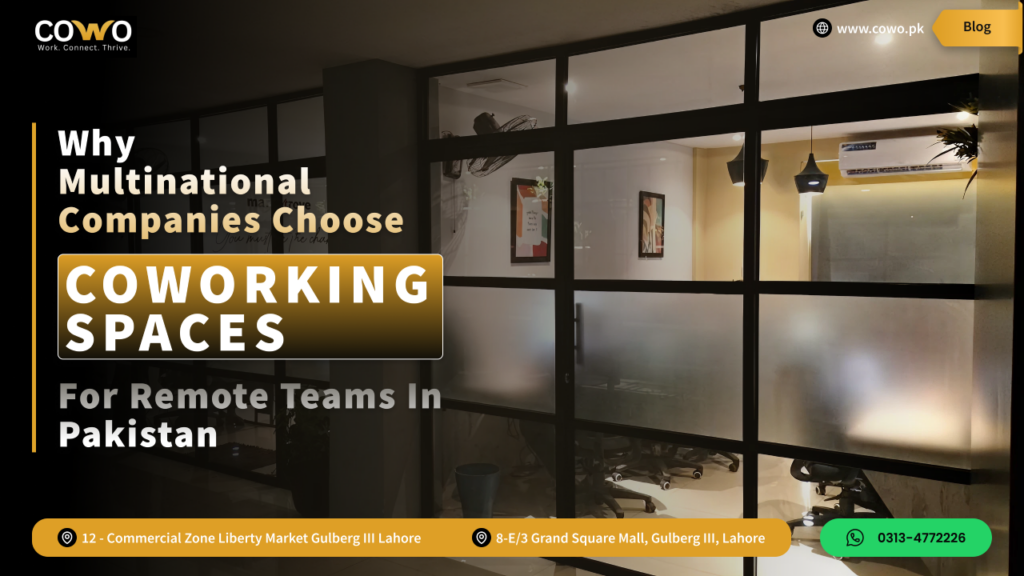
COWO operates two fully managed locations in Gulberg III, one at Liberty Market and one on the Main Boulevard opposite Centre Point Plaza. The enterprise workspace solution is built for teams of 20 to 200, with infrastructure, security, and facilities management handled end to end. For smaller or earlier-stage teams , private office plans provide dedicated, lockable space with all amenities included from day one. Companies including Bazaar, Oman Insurance, ML Sense, and MentorPak have placed teams there, which reflects the professional standard the space is built to maintain.
Set Up Your Pakistan Team in Days, Not Months
The companies that expand into Pakistan most effectively treat the workspace decision with the same seriousness as the hiring decision.
Talented people in a poorly managed environment underperform. A strong team dealing with unreliable internet, inconsistent power, and no professional structure wastes potential that took months to recruit. The workspace is not a background detail. It is part of what determines whether the team delivers.
Pakistan’s talent market is well-developed enough to build on seriously. Lahore’s commercial infrastructure is solid enough to operate confidently. And the managed workspace model, when the right space is selected, means a global company can have its Pakistan team fully set up, professionally housed, and operationally independent within days of making the decision.
That is why multinational companies keep coming back to this model. Not because it is the easiest choice on paper, but because it is the one that consistently works in practice.