

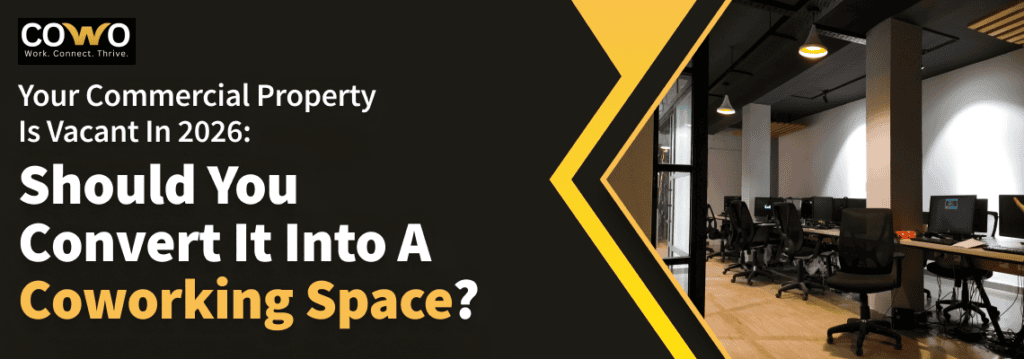
Your Commercial Property Is Vacant in 2026: Should You Convert It Into a Coworking Space?
A commercial property can stay empty for months without looking like an urgent problem. The building is still there, brokers may still be bringing occasional enquiries, and the owner can keep waiting for the right company to sign a long-term lease.
The financial picture is different. An empty floor produces no rent, while security, maintenance, repairs, taxes, financing costs, lifts, generators, and other building expenses may continue. The longer the space remains unused, the more reasonable it becomes to ask whether waiting for one large tenant is still the best strategy.
For some landlords in Lahore, converting a vacant commercial property into a coworking or flexible office space can offer another route. Instead of depending on one tenant, the property can accommodate private offices, team rooms, dedicated desks, meeting rooms, and shared work areas used by several businesses.
That sounds attractive, but there is an important difference. A conventional office is mainly a rental asset. A coworking space is both a property and an operating business. The decision should therefore depend on the building, local demand, conversion cost, occupancy potential, and expected net income rather than the popularity of coworking itself.
Why Flexible Workspace Is Becoming More Relevant in Pakistan
Pakistan’s digital economy gives landlords a reasonable basis for looking at flexible offices more seriously.
According to the Pakistan Economic Survey 2025-26, ICT export remittances reached US$3.388 billion during July to March FY2026, an increase of 19.7% compared with the same period a year earlier. Tech freelancer exports reached US$856.3 million, up from US$567.5 million, which represents growth of about 51%. The survey also reported 34,420 IT and IT-enabled services companies registered with the Securities and Exchange Commission of Pakistan by March 2026.
These are national figures, so they should not be treated as Lahore coworking occupancy numbers. What they do show is that Pakistan has a growing base of technology companies, service businesses, freelancers, remote teams, and professionals whose office needs are often different from those of traditional companies.
An eight-person software company, for example, may not want to sign a long lease, buy furniture, arrange backup power, install internet, and manage an entire office. A foreign company building a small Lahore team may want six or ten seats first and expand later. A consultant may only need a professional place to meet clients and work a few days each week.
Flexible workspace is designed around these situations.
Lahore’s Office Market Is Already Changing
The case becomes more interesting when Lahore’s own office market is considered.
Savills Research reported that Lahore had approximately 2.32 million square feet of existing Grade A and Grade B net leasable office space in the second half of 2024. About 51% of that supply was located in Gulberg and another 27% in DHA.
Savills also identified approximately 1.17 million square feet of upcoming Grade A and Grade B office space. Of that pipeline, around 62% was concentrated in Gulberg and 32% in Johar Town. The research noted strong demand for better-quality office developments, particularly from IT companies, financial services businesses, and multinational companies.
This matters to an owner with an older or vacant office because the competition is no longer limited to the building next door. Businesses can compare locations, parking, security, lifts, backup power, finishes, layouts, and overall workplace quality before choosing where to operate.
A vacant property therefore needs a reason for companies to choose it. Coworking can provide that reason in some cases by turning an empty shell into a ready-to-use workplace.
First Understand Why the Property Is Vacant
Before planning a coworking conversion, the owner should understand why the property has failed to attract a conventional tenant.
The problem may be the asking rent. It may be poor parking, an outdated interior, difficult access, an unreliable lift, weak power backup, or a floor plan that modern office teams do not like. In some cases, the property may simply have been marketed badly or priced above comparable offices.
Changing the business model does not automatically solve these problems.
In fact, some weaknesses become more serious in coworking because many unrelated people use the property every day. Poor parking affects dozens of members and visitors instead of one company. An unreliable lift becomes a daily frustration. A weak entrance affects every client walking into the space.
Coworking works best when the building already has a reasonable foundation and the conversion improves how that property is used.
Is the Building Actually Suitable for Coworking?
Location is the first test. The building should be reasonably easy to reach from the areas where its likely customers live or work. In Lahore, established commercial areas such as Gulberg, DHA, and Johar Town naturally attract office activity, although a strong building in another business cluster can also work.
Parking deserves serious attention. A floor may physically have room for 60 or 70 desks, but the building may not comfortably support 60 regular users plus visitors. Clients may arrive for meetings, candidates for interviews, and sales teams throughout the day. If parking is already difficult before the conversion, adding more daily users can make the experience worse.
The internal layout matters as well. Large, reasonably regular floor plates are generally easier to divide into private offices, meeting rooms, shared work areas, and circulation space. Awkward columns, narrow passages, deep unused corners, poor natural light, and badly positioned washrooms can reduce the amount of space that actually earns money.
The practical capacity of a coworking property is therefore not the maximum number of desks that can fit inside. It is the number of people the whole building can support comfortably.
Power and Internet Are Not Optional Extras
Reliable infrastructure is especially important in Lahore because people using professional workspaces expect to be able to work without repeatedly thinking about basic services.
Fast internet should ideally have a backup option so that one provider failure does not stop the whole office. Electricity, cooling, and backup power also need to support computers, meeting rooms, lights, networking equipment, and full daily occupancy.
These costs should be considered before the conversion starts. If the building requires major electrical upgrades, a larger generator, additional cooling, or expensive networking work, those expenses can change the investment case considerably.
A beautiful interior cannot compensate for unreliable internet or an office that becomes uncomfortable during a power problem.
Compare Coworking With a Normal Lease Properly
One of the easiest mistakes is comparing coworking revenue with conventional rent.
Suppose a landlord could lease a floor to one company for PKR 1 million per month. Now imagine the same property operating as coworking and producing PKR 1.7 million in monthly revenue.
At first sight, coworking looks clearly better.
The comparison is incomplete.
That PKR 1.7 million may still need to cover staff salaries, electricity, internet, backup power, cleaning, security, maintenance, software, marketing, sales costs, furniture replacement, repairs, refreshments, and daily management. The property may also require a large initial fit-out before any customer starts paying.
If monthly operating expenses reach PKR 700,000, the remaining operating income is close to the PKR 1 million conventional rent.
The landlord is now choosing between two models that may produce similar income while carrying very different levels of risk and management responsibility.
The useful comparison is therefore net income from coworking after operating costs and investment against net income from a conventional lease.
Break-Even Occupancy Matters More Than a Full House
Coworking projections often look impressive when every desk and private office is occupied. Real businesses rarely operate at perfect occupancy all year.
Members leave. Small companies reduce their teams. Some offices take longer to sell. Utility costs change, furniture wears out, and marketing expenses continue.
A landlord should calculate the occupancy level at which the workspace covers its monthly operating expenses. If a 50-seat property needs only 25 to 30 seats occupied to cover its costs, there is more room to handle slow months. If it needs 45 occupied seats just to break even, the business carries much more risk.
The financial model should therefore test weak, expected, and strong occupancy scenarios rather than assuming the best case.
The weak scenario is especially useful because it answers the question that matters when things do not go according to plan: can the property still survive?
Do Not Forget the First Few Months
A coworking space normally takes time to build stable occupancy. Opening the doors does not mean every private office will be filled immediately.
Potential customers need to discover the space, visit it, compare prices, negotiate, and decide whether to move. Larger team offices can take longer to close than individual desks.
This means the landlord needs to budget for more than construction. There should also be enough working capital to cover salaries, electricity, internet, cleaning, marketing, security, and other expenses while occupancy grows.
A project can look profitable over twelve months and still create cash-flow problems during its early stages if this ramp-up period is ignored.
You Do Not Have to Operate the Coworking Space Yourself
Property ownership and coworking operations are two different skills.
A landlord can operate the space directly, but that means building a team to manage leads, tours, contracts, billing, members, maintenance, complaints, marketing, cleaning, and daily operations.
Another option is leasing the property to a coworking operator under a conventional rental agreement. The operator manages the business while the landlord receives agreed rent.
Management and revenue-sharing arrangements create another structure. The landlord may provide the property and sometimes contribute to the fit-out, while an experienced operator manages the workspace and shares income according to the agreement.
Landlords who do not want to create an operating business from scratch can also examine managed coworking models for commercial properties and compare how these arrangements divide investment, responsibilities, expenses, and revenue.
The headline revenue percentage should never be the only thing considered. The contract needs to make clear who funds the fit-out, buys furniture, pays electricity and internet, employs staff, handles repairs, replaces equipment, and carries losses during low occupancy.
Those details determine what the property owner actually earns.
Keep the Conversion Flexible
A commercial property may have several different uses over its lifetime, so the coworking fit-out should not make the building difficult to lease traditionally in the future.
Creating dozens of tiny permanent rooms may increase the number of private offices today, but it can become a problem if a larger company wants the whole floor later.
Adaptable partitions, reusable furniture, sensible electrical planning, and meeting rooms that can be converted into offices can preserve future options.
The goal should be to improve the property rather than trap it inside one business model.
When Coworking Is Probably the Wrong Choice
Some vacant properties should remain traditional rental properties.
Coworking may not make sense when the building has severe parking problems, difficult access, unreliable utilities, poor internet options, an inefficient floor plan, major structural issues, or a conversion cost that would take too long to recover.
It can also be the wrong choice when the landlord already has access to a strong company willing to sign a sensible long-term lease. Predictable rental income with limited daily involvement can be more attractive than potentially higher revenue that requires greater investment and operating risk.
Local demand also matters. A landlord should look at nearby offices, coworking spaces, business activity, asking prices, and the type of companies already operating in the area before investing.
A vacant property creates pressure to act, but putting money into the wrong conversion can be more expensive than remaining vacant for a little longer.
Test the Idea Before Spending Heavily
Before starting construction, speak to commercial brokers, nearby businesses, freelancers, software companies, consultants, and small teams that could realistically use the space.
Find out what office sizes people request, what they dislike about nearby properties, what facilities they value, and what they are willing to pay.
A proposed floor plan can also be used to test demand before the full fit-out is completed. Interest becomes much more meaningful when a potential customer asks about reserving a six-person or ten-person private office at a specific price.
The objective is not to prove that people like coworking. It is to determine whether enough people want coworking in this particular building.
Should You Convert Your Vacant Commercial Property?
There are genuine reasons for Lahore landlords to consider flexible workspace in 2026. Pakistan’s ICT economy continues to grow, while Lahore already has a large professional office market and a significant pipeline of newer commercial developments.
Savills Research also estimated that roughly 1 million additional people could enter Lahore’s labour force by 2030. After accounting for upcoming office supply, it estimated that the city could require another 1 to 2 million square feet of Grade A and Grade B office space by 2030.
These numbers are encouraging, but they do not turn every empty floor into a good coworking investment.
A suitable property needs convenient access, workable parking, reliable utilities, strong internet, an efficient layout, and enough nearby demand. The financial model must also remain sensible after fit-out costs, monthly operating expenses, lower-occupancy periods, and the time required to build a customer base are included.
For some landlords, a traditional long-term tenant will remain the better option. For others, particularly where a well-located vacant commercial property has struggled to attract one large occupier, coworking can offer a different way to generate income from the same space.
The decision should come down to three things: whether people want to work there, whether the building can support them comfortably, and whether the numbers still work under realistic assumptions.
If those three pieces fit together, the conversion is worth serious consideration. If they do not, adding desks and meeting rooms will not fix the underlying property problem.