

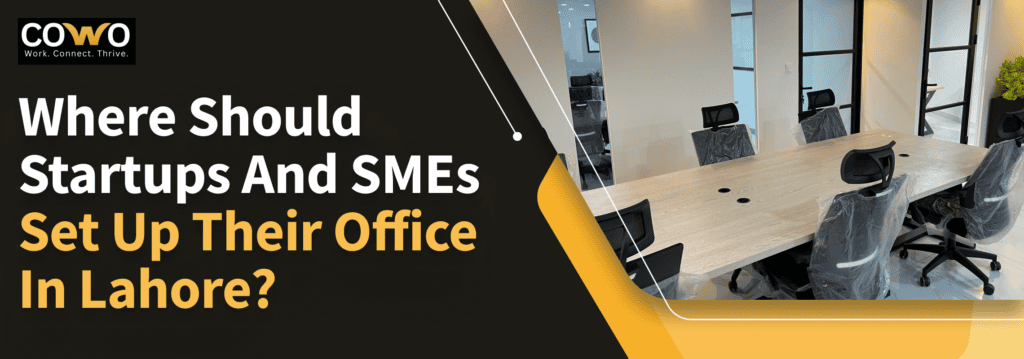
Where Should Startups and SMEs Set Up Their Office in Lahore?
A cheaper office is not always a cheaper place to run a business.
A startup might save money on monthly rent by moving farther from central Lahore, only to discover that employees are spending much longer in traffic, clients find the location inconvenient, and parking is a daily problem. Another company may pay more for its office but save time because its employees, customers, suppliers, and business services are all nearby.
For startups and SMEs, choosing an office in Lahore is therefore less about finding the lowest rent and more about finding a location that makes everyday business easier.
That decision matters in a city of Lahore’s size. According to the Pakistan Bureau of Statistics, Lahore District recorded 13,004,135 people in the 2023 Census, compared with 11,119,985 in 2017. The district was classified as 100% urban, with an annual population growth rate of 2.65% between the two censuses.
The size of the city gives companies access to a large workforce and customer base, but it also means office location can strongly affect commuting, accessibility, operating costs, and hiring.
Gulberg, Johar Town, DHA, Model Town, and Garden Town can all be sensible choices. The right one depends on how a particular business operates.
Start With Employees and Customers, Not the Address
Before comparing office buildings, look at where the people who will regularly use the office are coming from.
A software company whose developers mostly live around Johar Town, Wapda Town, Township, or Faisal Town may gain more from being based in that part of Lahore than from having a more expensive address elsewhere.
A consultancy that regularly meets clients coming from different parts of the city may have different priorities. Central access could be worth paying more for because employees and visitors have fewer difficulties reaching the office.
The same applies to traditional SMEs. An accounting firm may need easy client access and parking. A recruitment company may regularly receive candidates. A training business may need public transport nearby. A distributor may care more about road connections and storage than having an office in a premium commercial area.
The best location should match how the company actually works rather than how impressive the address sounds.
Gulberg Is Strong When Central Access Is Important
Gulberg remains one of Lahore’s most established business areas. Main Boulevard, MM Alam Road, Liberty, Gulberg II, and Gulberg III contain offices alongside banks, restaurants, hotels, retail businesses, and professional services.
Its biggest advantage is central access.
Gulberg is reasonably accessible from Cantt, Garden Town, Model Town, Jail Road, Ferozepur Road, and several central parts of Lahore. This can make it useful for businesses whose clients and employees are spread across different parts of the city.
It also sits within an established startup and technology ecosystem. National Incubation Center Lahore reports that it has incubated 350+ startups, while Plan9, run by the Punjab Information Technology Board, has operated from Arfa Software Technology Park since August 2012. Plan9 runs six-month incubation cycles for early-stage technology companies.
This does not mean startups need to be located near an incubator. It simply reflects the broader concentration of technology, services, entrepreneurship, and business activity around central Lahore.
The downside is cost.
Commercial rents vary considerably depending on the exact street, building, floor, condition, parking, furnishings, elevators, and backup power. Current property listings show that offices of similar sizes can have very different asking prices even within Gulberg.
For a growing company, this makes total cost more important than the neighbourhood name alone.
Gulberg usually makes the most sense for businesses that regularly meet customers, need central access, or have employees travelling from several different parts of Lahore.
Johar Town Is Practical for Technology and Service Teams
Johar Town can be a stronger operational choice when much of the team is based in southern Lahore.
It provides access to Faisal Town, Township, Wapda Town, Canal Road, Raiwind Road, Multan Road, and Thokar Niaz Baig. This geography can work particularly well for software houses, digital agencies, education businesses, healthcare companies, e-commerce operations, and service-based SMEs.
The area also has substantial commercial office availability, with properties ranging from small offices to complete floors suitable for larger teams.
For a technology company serving customers overseas, the advantages can be straightforward. The business may not need customers walking through the door every day. What matters more may be reliable internet, electricity backup, reasonable employee commute times, sufficient parking, and enough space for the team to work comfortably.
That changes the value calculation.
Paying extra for a prestigious address provides little benefit if most clients communicate through Zoom, email, or project-management platforms and employees have to cross Lahore every morning to reach the office.
Johar Town is therefore particularly worth considering when employee convenience and functional office space matter more than being located in Lahore’s traditional central business areas.
DHA Makes Sense When the Business Already Has a Reason to Be There
DHA can work very well for the right business, particularly when employees or customers are already concentrated around DHA, Cantt, Askari, Cavalry Ground, and nearby areas.
Its commercial districts suit real estate companies, consultancies, design firms, technology businesses, healthcare services, financial services, and companies targeting customers in surrounding residential areas.
The key is having a genuine geographical reason for choosing it.
A company employing people who mostly live around Cantt and DHA may find the location extremely convenient. The same office could create a difficult daily commute for a team travelling from Johar Town, Township, or Wapda Town.
Current property listings also show why DHA should not be treated as one rental market. Recent Zameen listings for DHA Phase 4 have included 900 sq ft offices around PKR 70,000 to PKR 90,000 per month, alongside considerably more expensive larger offices.
These figures are individual asking prices rather than average market rents. Exact costs can change considerably based on the phase, commercial block, floor, parking arrangements, fit-out, furnishings, and condition of the building.
DHA is strongest when its location directly supports the company’s existing workforce or customer base.
Model Town and Garden Town Offer a Useful Middle Ground
Model Town and Garden Town may not receive as much attention as Gulberg or DHA, but they can work well for SMEs that want convenient access to both central and southern Lahore.
Their connections with Ferozepur Road, Canal Road, Faisal Town, Muslim Town, Gulberg, and surrounding areas make them worth considering for agencies, healthcare businesses, accountants, recruitment firms, training companies, small software teams, and other professional services.
The bigger issue is often the building rather than the neighbourhood.
Office quality can differ significantly. One property may have reliable elevators, parking, fibre internet, security, and good backup electricity, while another building nearby may struggle with several of these basics.
This makes physical inspection essential.
A renovated office with attractive interiors is not a good business location if employees cannot park nearby or the lift is unreliable. For an SME planning to stay several years, these daily practical problems matter more than how impressive the office appears during a viewing.
Public Transport Can Affect Hiring and Retention
Not every employee commutes by car, particularly junior employees, interns, customer-support staff, and people early in their careers.
Lahore’s public transport network should therefore be considered when choosing a workplace.
According to the Punjab Transport Department, Lahore’s Metrobus operates along a 27 km route from Gajjumata to Shahdara with 27 stations. The system has been operational since February 2013.
The Orange Line Metro Train runs for 27.1 km between Ali Town and Dera Gujran and has 26 stations.
An office does not need to be directly beside a Metrobus or Orange Line station to benefit from public transport. However, easy access to major routes can noticeably improve the commute for employees coming from different parts of Lahore.
Distance alone can also be misleading.
An office eight kilometres away through difficult traffic may take longer to reach than one twelve kilometres away with better road or public transport connections. Businesses should compare realistic door-to-door commute times rather than simply looking at distances on Google Maps.
Startups Should Think Carefully Before Taking Too Much Space
A common problem for early-stage companies is trying to predict their future office needs too early.
A startup with eight employees may expect to have twenty within a year and lease a much larger office in advance. If hiring happens more slowly than expected, the company ends up paying for unused desks.
The opposite problem also happens. A team leases a small office, grows faster than expected, and has to move again after six months.
Pakistan’s technology economy makes this particularly relevant. The Pakistan Economic Survey 2025-26 reports that IT services exports reached about US$3.4 billion, growing 19.8%, with software consultancy and freelance digital services contributing to the sector’s performance.
Growing technology and service businesses often have changing headcounts and hybrid working patterns. This is one reason a coworking space in Lahore may make sense for some smaller teams before they commit to a larger dedicated office.
It is not automatically the cheaper option for every company. Once an SME has stable staffing and expects to remain in the same location for several years, leasing and operating its own office may provide better control over layout, privacy, equipment, branding, and long-term costs.
The workspace model should follow the company’s stage and operating needs.
Calculate the Real Monthly Cost of an Office
Rent is only one part of office expenditure.
A conventional office may require a security deposit and advance rent before the business even moves in. Furniture, air-conditioning, networking, internet installation, meeting-room equipment, electricity backup, security, cleaning, repairs, and general maintenance add further costs.
For established SMEs, some of these expenses can be spread over several years. For early-stage businesses, however, large upfront costs can put unnecessary pressure on cash flow.
The better comparison is total occupancy cost.
A lower-rent unfurnished office could eventually cost more than expected once the company installs desks, networking equipment, backup power, and air-conditioning. A ready-to-use office may cost more each month but require less initial spending.
Neither model is automatically better. Companies should calculate what each option will actually cost over at least the first 12 months.
Check Parking, Internet and Power Before Signing
Some office problems only become visible after employees move in.
Internet availability should be verified with the provider rather than relying solely on the landlord. The same applies to power backup. Ask what equipment is installed, what it covers, and how long it can support normal office operations.
Parking deserves equal attention in Lahore.
Employees arriving individually by car or motorcycle can quickly create difficulties if a building has limited dedicated parking. Client-facing businesses should also consider where visitors will park during busy hours.
Security, elevator reliability, air-conditioning, mobile reception, washrooms, accessibility, and maintenance responsibilities should all be checked before signing a lease.
A slightly less attractive office with dependable infrastructure can be far easier to operate than an impressive space with recurring practical problems.
Visit the Location During Lahore’s Peak Hours
An office viewed in the middle of the afternoon may feel completely different at 9:00 a.m. or 6:00 p.m.
Visit shortlisted properties during normal commuting hours. Look at traffic entering and leaving the area, parking availability, road access, and how busy the surrounding commercial streets become.
It can also help to ask several employees to calculate or test their commute.
A founder only experiences one route to the office. A company with twenty employees may have people travelling from ten different parts of Lahore.
That wider picture should influence the final decision.
So, Which Lahore Area Is the Right Choice?
For businesses that need central access, regular client meetings, and connectivity with different parts of Lahore, Gulberg is a strong option. Johar Town often makes more sense for technology and service companies with employees based around southern Lahore. DHA is practical when customers and employees are already concentrated around DHA, Cantt, and nearby neighbourhoods. Model Town and Garden Town can offer a useful balance for professional services firms and SMEs that need connections with both central and southern Lahore.
The right answer ultimately comes from the company’s own operations.
Where do employees live? How often do customers visit? What will the office really cost after utilities and services? Is public transport important to the workforce? How much space will the business realistically need next year?
The most expensive business address is not automatically the best location, and the cheapest rent is not necessarily the best deal.
For a startup or SME in Lahore, a good office is one that employees can reach without unnecessary difficulty, customers can visit conveniently, the business can afford comfortably, and the company can continue using it as its needs change.